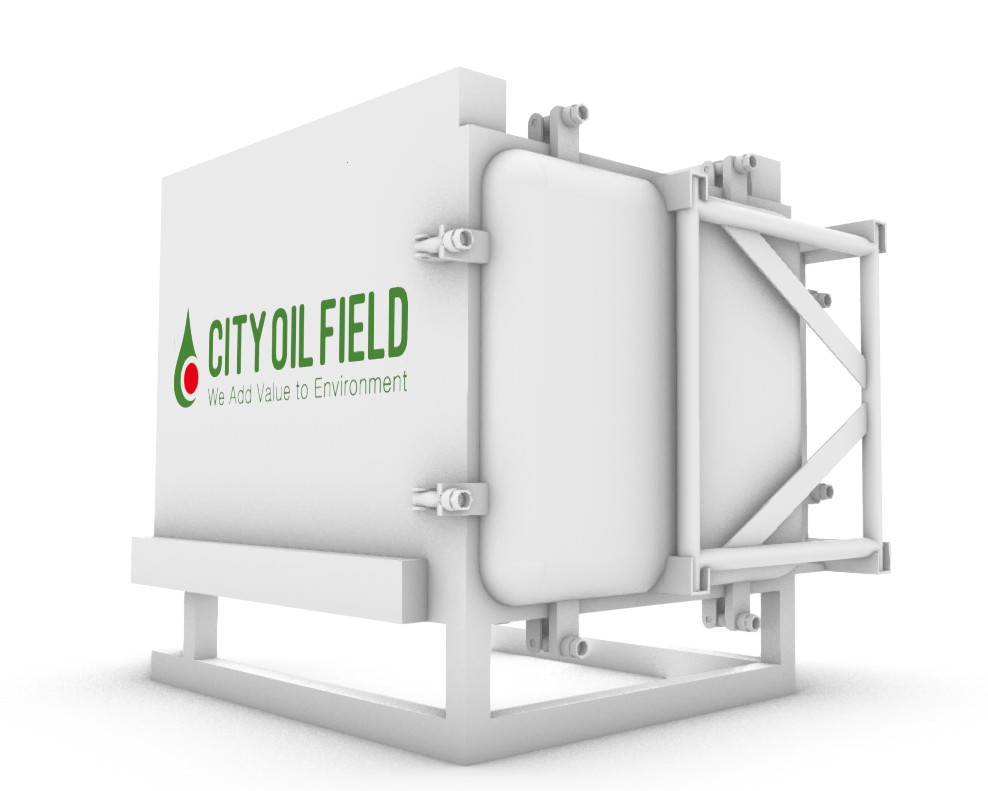
RGO IS WHERE RESIDUAL PLASTIC BECOMES VALUE

RGO is not an auxiliary add-on at the final stage of Plastic EX.
It is the core production engine that converts residual plastic — what conventional recycling cannot absorb — back into industrial value.

If Plastic EX organizes resource flows as an operational protocol,
RGO is the cyber-physical production core that completes that protocol through physical production.

Low-Temperature
Restoration-Based
Regenerated Oil Engine

RGO stands for Regenerated Green Oil — Plastic EX's core restoration technology, engineered to convert waste plastic into high-quality regenerated oil. Defined as a low-temperature, non-combustion system based on ceramic wave decomposition, mixed waste plastic is converted under oxygen-free, non-combustion conditions into regenerated oil, carbon black, and non-condensable gas.

RGO is not simply "a device that makes oil." It is the production layer that transforms residual lots recovered by Plastic EX into restorable industrial feedstock — and it sits at the center of Proof of Processing, linking collection events to verified process inputs and outputs.

Input
arrow_forward
Wave Decomp. Reaction
arrow_forward
Output
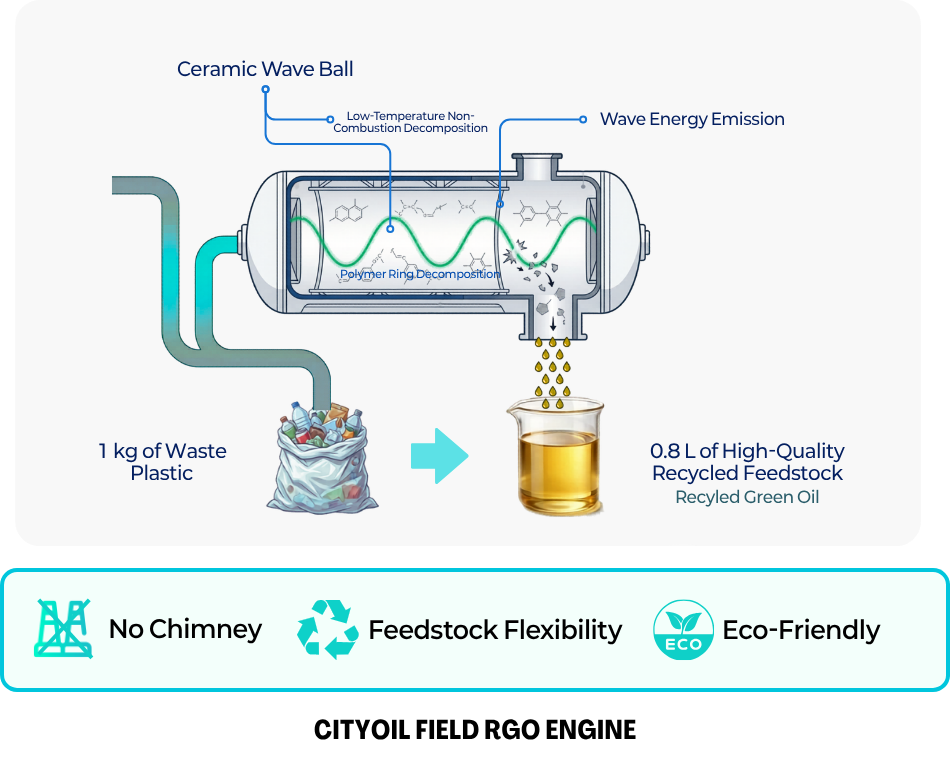
RGO Engine System

Plastic EX is
incomplete
without RGO

The Plastic EX value chain does not end at collection. Once plastic passes through the stations and sorting process, a critical question must be answered: where does this lot go next?

Lots eligible for direct recycling follow the recycling path. Low-grade or mixed lots that conventional recycling networks cannot absorb move to the restoration path. RGO is the central mechanism that connects this restoration path to the real economy.

RGO is the downside safety net for the entire Plastic EX structure. By providing an economic absorption pathway for residual lots that recycling alone cannot handle, it underpins the viability of the entire collection and verification network.

Without this function, Plastic EX could remain a platform for collection and data logging — but it could never complete the closed-loop structure that extends all the way to real production value.

inventory_2

Collected Lot Classification Complete

Single-material / high-grade → Recycling path

Mixed / low-grade → RGO Restoration

water_drop

Regenerated Oil Production Confirmed

Low-temp, Non-combustion,
Direct Feed

RGO stands on a fundamentally different technical foundation from conventional high-temperature pyrolysis. By operating at lower temperature ranges with a simpler feed structure, it achieves both economic viability and deployment suitability simultaneously.

Category Conventional High-Temp Pyrolysis RGO Ceramic Wave Decomposition
Operating Temperature 450–700°C ~270±20°C
Decomposition Method High-temp combustion / pyrolysis Non-combustion wave decomposition
Yield Rate 50–70% (variable) 80%+
Pre-treatment Requirements Separation by material type required Mixed direct feed capable
Environmental Profile Smoke, odor, and dust emissions Zero smoke · zero odor · zero dust
Urban Deployability Limited to centralized outskirt facilities Urban-fit, modular deployment
Continuous Operation Batch cycle required 24-hour continuous operation capable

* Based on internal business plan figures. The technical value of RGO lies in its potential to bring the restoration process into the infrastructure of an urban circular economy.

RGO does not
process everything

RGO's most important operating principle is clear: recycling comes first, and restoration absorbs what recycling cannot.

A

Below contamination threshold, single material type, direct recycling with positive contribution margin

Material Recycling
B/C

Mixed material or above contamination threshold, meets RGO feed eligibility criteria

RGO Restoration
Q

Excluded from all reward pools; routed to a separate cost account

Quarantine

This principle matters because it translates the phrase "don't burn it, restore it" into an actual operating rule. Plastic EX does not position restoration as a substitute for recycling. By distinguishing the roles of recycling and restoration, and assigning each path to the most appropriate lots, the system achieves both environmental legitimacy and economic sustainability at once.

RGO is where
production data is born

In Plastic EX, verification does not end at the collection stage. Final value can only be confirmed once it is established what was fed into the actual process and what was produced at what yield rate.

inventory

Input Lot

Weight, material type, contamination level, and acceptance data generated at stations and sorting

Weight Material Type Contamination Acceptance Confirmed
settings

Process Batch

RGO batch feed volume, process parameters, yield rate, and measured by-product records

Feed Volume Batch ID Measured Yield
description

Output Record

Regenerated oil, carbon black, and non-condensable gas outputs — basis for blockchain settlement and carbon accounting

Regen. Oil Carbon Black Gas Recovery

These records are not simple operating logs. They form the evidentiary basis of Proof of Processing — proving which lots were actually fed into the restoration process and what quantities were produced as a result. RGO is the critical layer that converts collection events into production events.

The core revenue source
of the real economy

RGO is not simply a cost center for plastic disposal. It is a production center at the heart of the real economy, anchored by regenerated oil.

Built on this structure, Plastic EX becomes not a platform that stops at collection and sorting, but an integrated circular economy model that drives real industrial production. Regenerated oil sales generate tangible revenue; the processing operation generates carbon data and ESG value; and verified process records provide the foundation for digital settlement and trading structures.

water_drop

Recovered Oil

Core tangible revenue stream

layers

Carbon Black

By-product monetization

air

Non-Cond. Gas

Internal energy recovery

eco

Carbon Data

ESG / carbon accounting basis

RGO Production Facility

Engineered not just
for performance, but for trust

When presenting RGO, what matters is not making it appear to be "good technology" — it is demonstrating why markets and partners can actually trust it.

verified_user

ISCC PLUS

Supply chain traceability certification — International Sustainability and Carbon Certification

military_tech

NET No. 1383

National New Technology designation — Korea's official new technology certification

corporate_fare

PSM Zero-Defect

Process Safety Management zero-defect — commercial plant safety verified

trending_up

KTL Yield Verification

Korea Testing Laboratory — 80%+ yield rate officially verified

copyright

138 Patents

Core technology patent portfolio — proprietary technical defense foundation

public

Global Offtake

Certification-backed global offtake contract capability established

These are not mere marketing badges. They are the basis for establishing trust across distinct dimensions — supply chain traceability, national new technology status, commercial plant safety, and verified yield rates. RGO should not be described by its technology alone — it must be understood as a trustworthy production infrastructure that enables real commercialization and global offtake.

The production core
that completes
the value chain

If Plastic EX is the operating system for collection, verification, sorting, and trading, then RGO is the production core that connects that system to real production, revenue, and carbon value.

Collection alone does not complete an asset. Verification alone does not create a market. Trading alone does not close the loop. RGO converts residual lots into industrial value, and in doing so, feeds the resulting production data back into settlement and carbon accounting.

inventory_2 Collection
verified_user Verification
history Sorting & Routing
local_fire_department
RGO — Restoration Production Core

Physical production · Carbon data · Settlement linkage

payments Settlement

This is precisely why RGO must be understood within Plastic EX not as "one technology among many," but as the critical layer connecting the protocol to the real economy. If Plastic EX is the structure that converts urban waste flows into verifiable carbon asset flows, then RGO is the final engine that locks in that conversion as real production value.

RGO is how
Plastic EX turns
residual flow
into real output

Residual plastic that recycling cannot absorb is not simply a failure stream.
It remains a restorable resource — one that can return to industrial value
when the right technology is paired with the right system.

RGO is what makes that conversion happen.
If Plastic EX organizes resource flows through collection and verification,
RGO is the engine that turns the residual portion of those flows into real production and tangible value.

Economic
Architecture

See how RGO connects to tangible revenue, carbon value, and the digital settlement structure.

Economy arrow_forward