Plastic EX's system is not a simple collection network.
It is an integrated operational protocol that inspects waste plastic recovered from across the city,
batches it, determines routing, and connects it all the way through processing and settlement.
Collection becomes an event. That event becomes data through verification.
And data becomes the starting point of a value flow that leads to trading, restoration, and settlement.
Plastic EX is designed to make this entire process operate on a single state machine.
Conventional collection businesses focus mainly on "how much was gathered." Plastic EX addresses far more important questions.
What was recovered, and from where?
What quality was it inspected at?
Which batch was it assigned to?
What routing did it take?
What outcome was it settled at?
Even the same 1kg of plastic has different final value depending on which channel it was recovered from, what grade it was assessed at, and what routing it took. The core of the system lies not in volume, but in state management and routing management.
Plastic EX does not impose the same collection method on every market. It deploys the most suitable entry point based on each city's labor costs, local logistics structure, volume of irregular waste, and user behavior patterns.
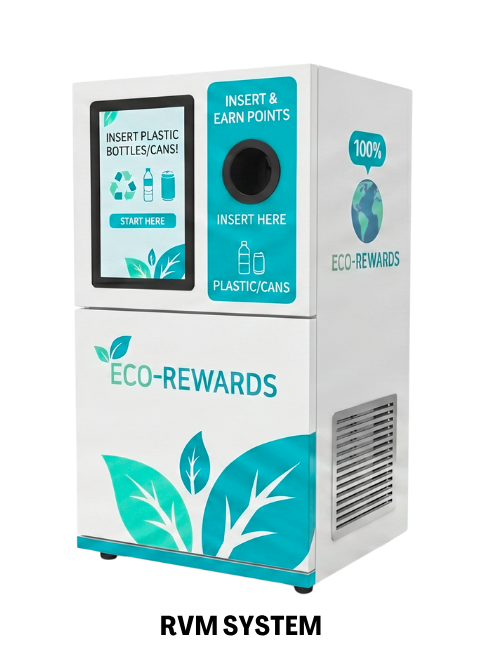
The RVM is an unmanned gateway designed for rapid recovery of standardized items. App integration, QR recognition, item deposit, on-site assessment, and projected reward display all operate within a short, repeatable UX loop.
To the user it looks like a simple drop-off experience, but internally the system simultaneously creates a collection event, runs a first-pass oracle verification, transitions to a pending-reward state, and schedules batch merging.
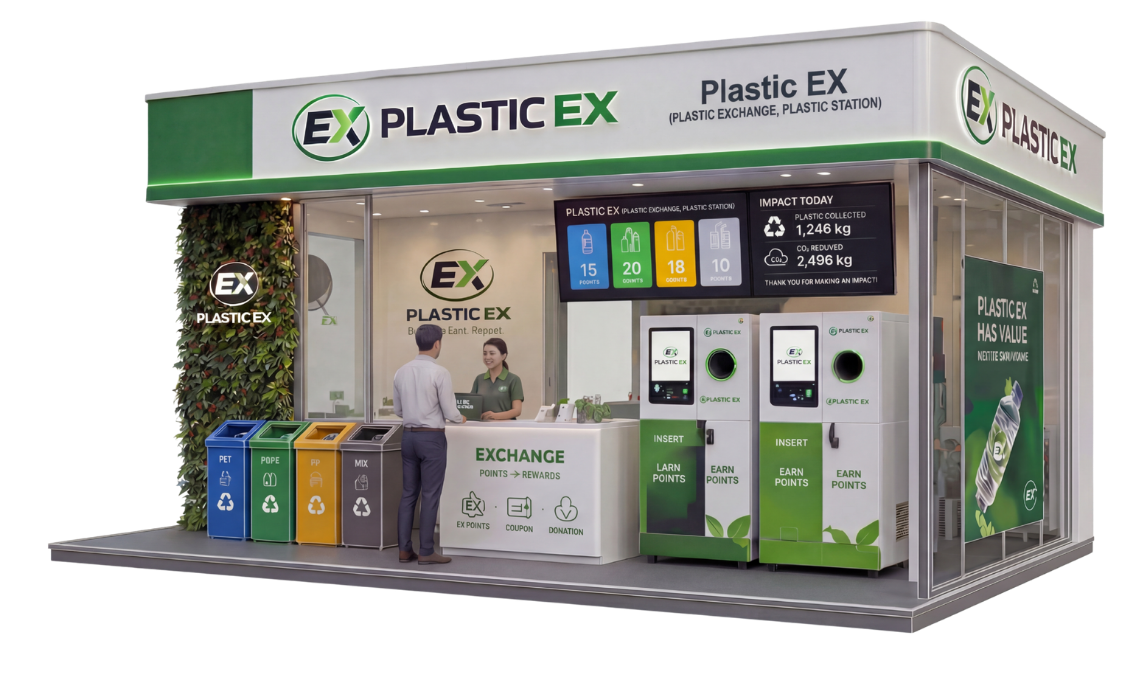
Plastic Station is a staffed local hub that handles large-volume and irregular waste. It can achieve higher collection efficiency especially in markets where motorcycle-based micro-collectors and neighborhood aggregation networks already exist.
Here, weight measurement, material classification, on-site inspection, photo documentation, and handoff confirmation all occur together, formally bringing recovered volume into the system.
One Network
The RVM and Plastic Station are different devices, but the system logic is the same. Different entry points, but everything that follows — inspection, batching, routing, processing, and settlement — runs on the same rules. This is precisely what makes Plastic EX an operational protocol, not an equipment business.
One of the most important principles in Plastic EX is that collection alone does not immediately confirm value.
Device Oracle
Unmanned First-Pass Verification
The device generates an event payload, signs it locally, and transmits it to the system. It must pass exception rules — repeated deposits, weight deviations, abnormal consecutive inputs — before being promoted to the next state.
Human Oracle
Staffed On-Site Verification
Operator confirmation, on-site photos, handoff records, re-inspection, and hub-level review are applied in layers. The system is designed so that no single claim alone can finalize an outcome.
Process Oracle
Processing Verification
Process data — actual input volume, yield, by-products, recovered oil output — is linked to the lot. This is the moment when a collection event converts into a production event.
Audit Oracle
Final Audit Verification
Final settlement executes only when at least two layers of verification have accumulated. The oracle is not a sensor — it is a trust mechanism that confirms economic rights.
The RVM or Plastic Station generates a collection event. At this stage, volume enters the system, but economic rights have not yet been confirmed.
Status: PendingA device oracle or human oracle verifies the event and updates its state. Only once verification passes can the volume advance to the next stage.
Status: EligibleMultiple individual events are merged into an operational lot under a single Lot ID. Each single deposit is converted into a batch unit that becomes the basis for trading and processing.
Status: Lot-LinkedThe lot branches into one of three paths: recycling, restoration, or quarantine. This is the stage that determines downstream value and settlement structure.
Actual processing data — linked to sorting, restoration, production, and dispatch — is attached to the lot. At this point, the collection event converts into a production event.
Status: Process-BoundRewards, fees, operator settlements, and collateral adjustments are executed. The final accrual or settlement result visible to the user is only confirmed after this entire flow completes.
Status: SettledThe core of Plastic EX is not about collecting more — it's about routing correctly. Restoration is not treated as a substitute for recycling. Lots where recycling yields higher economic and environmental value are sent to recycling first.
Material Recycling
Single-material lots below contamination thresholds with high direct recycling contribution margin
Restoration
Mixed or low-grade material lots that meet RGO suitability criteria
Quarantine
Lots with high quality risk — such as PVC contamination or hazardous pollution — handled separately
Southeast Asia / Developing Markets
Staffed Plastic Stations can achieve higher collection efficiency. Human handoffs and on-site inspection become the backbone of the system.
Advanced Economies
Unmanned RVMs are the better fit. Device Oracles and remote monitoring become the backbone of the system.
Plastic EX is not a structure that replicates a single device worldwide. Deployments differ by market, but the value chain and settlement logic downstream of collection are maintained under a single protocol. This is what makes Plastic EX not a site-specific model, but a scalable operating system.
What the Plastic EX system ultimately does is straightforward. It recovers dispersed waste plastic from across the city, organizes it into a verifiable state, routes it along the most appropriate path, and connects it all the way through to production and settlement.
As a result, the movement of waste becomes not mere logistics, but an asset flow. Collection is not an ending action — it becomes the starting point that leads to trading, production, carbon data, and settlement.
Plastic EX System Does
Not operating equipment —
building the operational infrastructure for an urban circular economy that actually works.
This is the role of the System — turning Vision into reality.
A circular city is not built by declaration alone. It requires real operational infrastructure — where collection leads to verification, verification leads to batching and routing, and routing leads in turn to processing and settlement.
Drawing the waste plastic of the city into the system,
and converting that flow into a state that is traceable, verifiable, and settleable.
That is the role of the Plastic EX system —
and the way an urban resource extraction protocol operates in the real world.
Next
See how the remaining lots that Plastic EX has verified and routed
are converted into real industrial value.