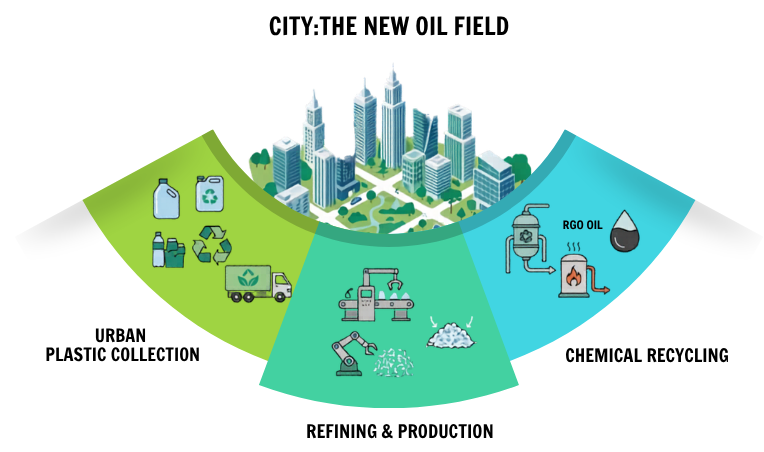
Plastic EX is an urban circular economy protocol that transforms dispersed waste plastic flows across cities
into verified, recoverable asset flows — inspectable, restorable, and settleable.
We see waste plastic not as mere trash, but as an urban carbon asset
that can be recovered, sorted, and valorized again.
Plastic EX begins not with processing technology,
but with a fundamental shift in perspective — reinterpreting urban waste as an asset.
Plastic EX's core thesis is simple:
the city is an oil field, and waste plastic is a recoverable carbon asset.
In conventional industry, oil is valued through exploration, transportation, and refining. Plastic EX applies this same structure to urban waste flows.
From this perspective, waste plastic is not discarded — it's simply a resource layer not yet recovered.
Plastic EX builds the operational structure that connects this hidden resource layer to real industrial value.
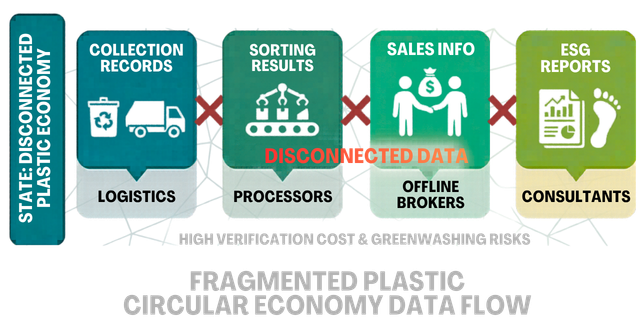
The inefficiency of today's plastic circular economy isn't simply a lack of collection. The deeper problem is that material flow data and value assessment information are disconnected from each other.
Collection Records
stay with the logistics provider
Sorting Data
remain with intermediate processors
Sales Data
scattered across offline trading networks
ESG Reporting
compiled in separate document systems
The physical materials move, but the data needed to describe and verify that movement is never connected.
Within this fragmented structure, waste plastic cannot function as a stable asset,
and trading, carbon value, and settlement structures cannot be coherently designed.
Plastic EX is not a simple collection service. Nor is it a simple trading platform. Plastic EX is the structure that brings urban waste plastic flows into a single continuous system: collection → inspection → sorting → trading → restoration → settlement.
Collection becomes an event
Not a simple logistics act, but a verification event that generates data.
The event becomes data
Through inspection, weight, material type, condition, and routing are converted into trustworthy records.
Data becomes tradeable units
Through classification and routing decisions, it becomes asset units that can be traded in the market.
Outcomes connect to production, carbon, and settlement
RGO restoration, carbon accounting, and digital settlement are connected in a single pipeline.
In the existing system, ordinary citizens' participation was mostly limited to symbolic waste separation. Small-scale return actions, while environmentally meaningful, were difficult to expand into economic activity within existing financial and settlement structures.
Plastic EX changes this. We define participation in collection not as a mere disposal act, but as a micro-mining act — recovering dispersed resources from within the city.
This shift is not simply the introduction of a reward system.
participation connects to data
data connects to verification
when verification leads back to trading, restoration, and settlement
only then does a citizen's action gain real economic function within the circular economy.
Plastic EX is the first layer that makes this transformation real.
Single-material plastics that can be recycled are sent to recycling first. We use the route with the highest economic and environmental value.
Low-grade and mixed lots that conventional recycling networks cannot absorb are routed to RGO restoration.
Loads with high contamination risk or significant quality concerns are set aside for separate quarantine and review.
In short, Plastic EX is not a single-processing model, but a layered circular operating system that coordinates both recycling and restoration. Only within this structure can urban waste be transformed into an asset flow with greater efficiency and greater trust.
Plastic EX's long-term goal is not simply scaling up collection volume. Nor is it a token project. What we aim for is to define the operating rules of the global circular economy value chain — spanning collection, trading, restoration, carbon accounting, and data settlement — before anyone else does.
Platform
A digital platform connecting collection and trading
Infrastructure
RVM, Plastic Station, RGO physical infrastructure
Data
Verifiable data architecture for collection, inspection, and restoration
Settlement
Reward, trading, carbon accounting, and digital settlement systems
Collection infrastructure alone lacks scalability.
Tokens alone lack physical value.
Restoration equipment alone lacks data trust.
But when these four elements combine within a single structure,
they create a system where participation incentives, physical flows, and digital trust mutually reinforce each other.
What Plastic EX ultimately creates is one thing: transforming urban waste plastic flows into verified carbon asset flows.
Within this structure, recovery becomes not mere logistics but data. Data becomes the standard for quality assessment and trading. Trading and restoration connect back to industrial value, carbon value, and digital settlement.
Therefore, Plastic EX is
Not a service that collects plastic, but a protocol that transforms it into:
traceable,
verifiable,
and settleable asset flows.
A circular city cannot be built by a single factory. It begins with creating the gateway that draws dispersed waste plastic back into the system.
Plastic EX is that first layer.
Citizen participation into collection events,
collection events into verifiable data,
verified data back into tradeable, restorable, and settleable value flows.
That is the starting point of the urban resource-mining protocol that Plastic EX creates.
Next
See how collection, inspection, sorting, trading, restoration, and settlement
connect into a single system.